Joint Replacement Surgery in Multan
Joint replacement surgery in Multan. This page explains what the operation involves, when it is considered for a knee or hip destroyed by arthritis, and what recovery realistically looks like.
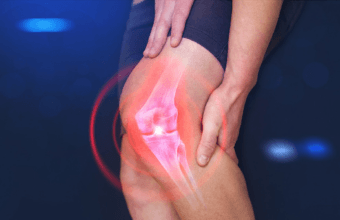
Joint Replacement Surgery: what it involves
Joint replacement, or arthroplasty, removes the worn surfaces of a damaged joint and replaces them with precision-engineered implants of metal and high-grade polyethylene. It is the most reliable treatment we have for a joint that has been destroyed by advanced arthritis, and for most patients it means walking, climbing stairs and praying comfortably again after years of guarding every step.
Planning matters as much as the operation itself. Weight-bearing X-rays and an assessment of limb alignment, ligament balance and bone quality are used to work out implant size and position beforehand, because an implant that sits correctly is the one that lasts. Which joint is suitable for replacement, and whether replacement is the right step at all, is decided case by case after examination.
Surgery is not the first answer for everyone. Where a joint still has cartilage left, medication, injections, weight management and structured physiotherapy usually come first, and replacement is kept in reserve. Anyone considering the operation should understand clearly what an implant is expected to give them, and what it will not.
This page gives general information about joint replacement surgery and is not a diagnosis or a treatment plan. What is right for you depends on your own examination, imaging and medical history. Please discuss your case at a consultation.
Consultation details
- Consultation
- Rs. 2,000
- Timings
- Mon to Sat, 2:00 to 7:00 PMFriday, 3:30 to 8:30 PM
- Clinic
- Fatima Medical Centre, Chowk Rasheedabad, Multan
Treated by Dr. Rizwan Ghafoor, BSc, MBBS, MRCPS(Glasg), FCPS (Tr & Orth), FACS(USA).
- Member: AAOS, USA
- Member: Pakistan Orthopaedic Association
- Member: Royal College of Physicians and Surgeons of Glasgow
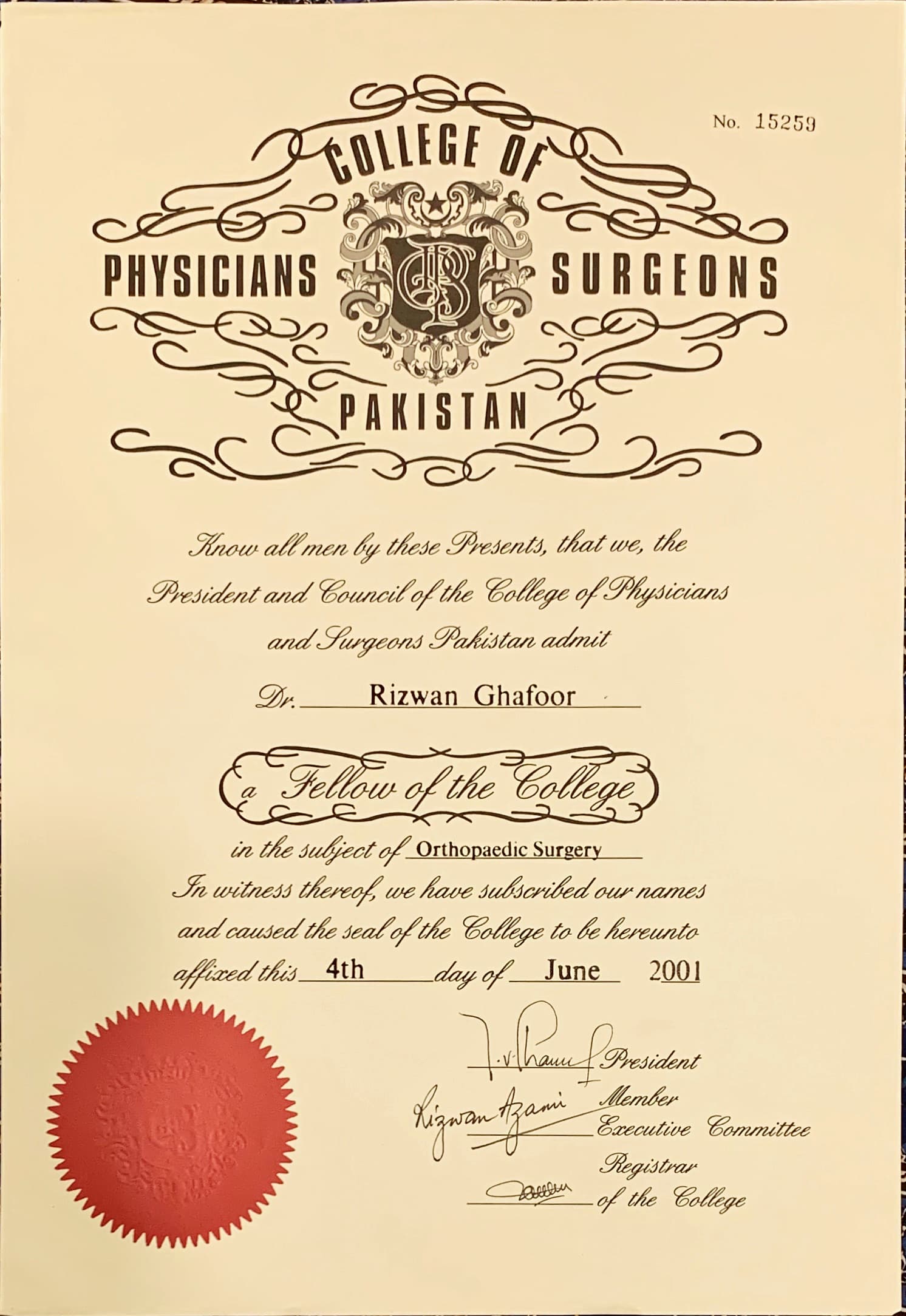
- Fellow: College of Physicians and Surgeons Pakistan
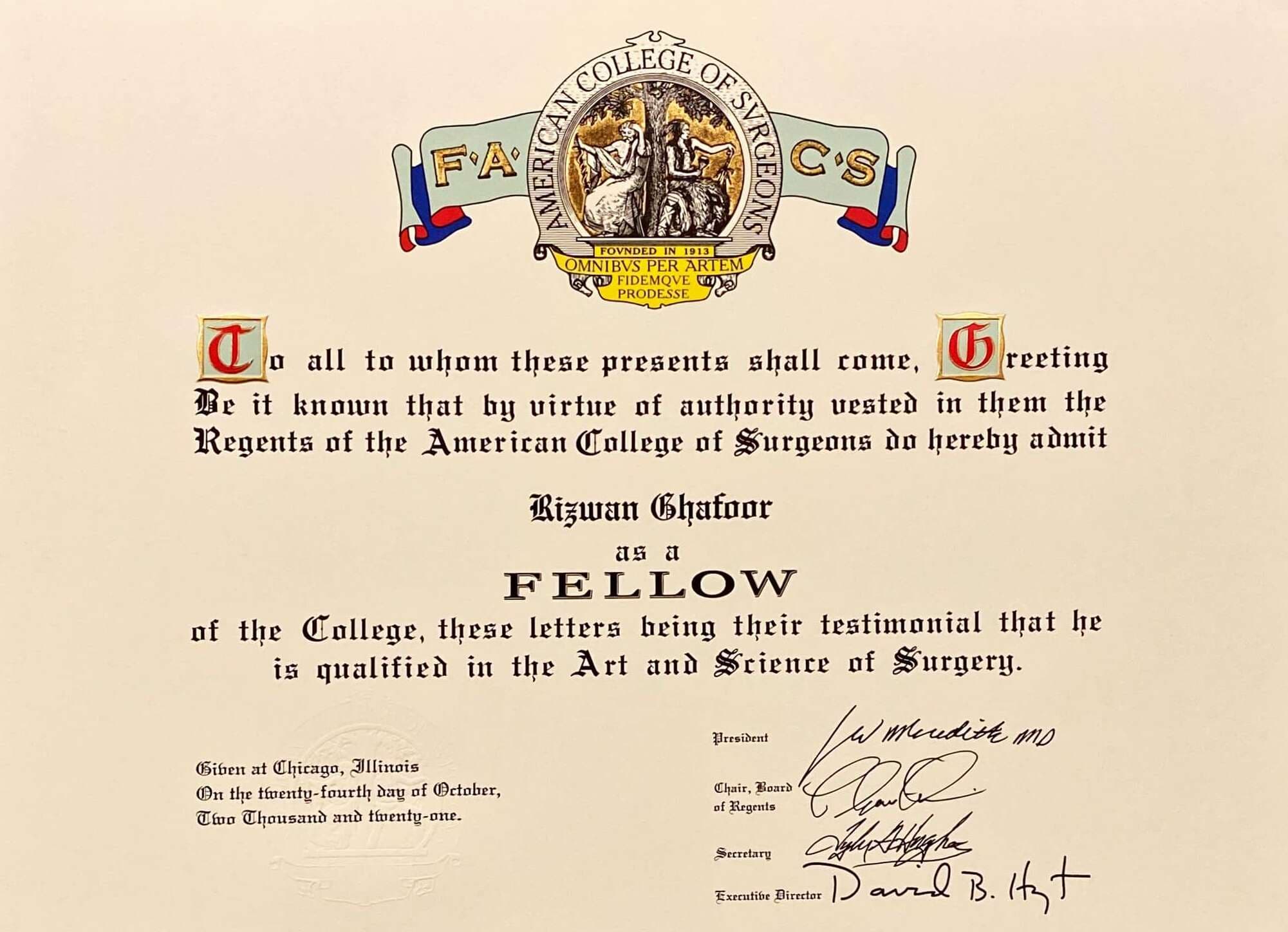
- Fellow: American College of Surgeons, USA
What this treatment addresses
- Advanced osteoarthritis of the knee or hip
- Rheumatoid arthritis with joint destruction
- Avascular necrosis (AVN) of the hip
- Post-traumatic arthritis after an old fracture
- Bow legs and knock knees with joint wear
- Failed or loosened previous implants needing revision
- Hip fractures in older patients requiring hemiarthroplasty
- Severe shoulder arthritis and rotator cuff arthropathy
What to expect
- 01Assessment and X-raysA full examination, weight-bearing X-rays and a review of how much the pain is limiting your daily life and work.
- 02Planning and fitness checkImplant size and alignment are planned from your films, and blood sugar, blood pressure and heart fitness are optimised before surgery.
- 03Surgery and same-week mobilisationMost patients stand and walk with support within 24 hours of the operation, with pain controlled by a multi-modal regimen.
- 04Physiotherapy and follow-upA home exercise programme, with follow-up reviews to check movement, wound healing and the position of the implant.
Recovery
Most knee and hip replacement patients walk with a frame or stick within a day of surgery, manage stairs by two to three weeks, and return to routine daily activity between six and twelve weeks. A modern, well-positioned implant is expected to last fifteen to twenty years or more.
Joint Replacement Surgery: common questions
- How long does a knee replacement last?
- A modern, correctly aligned knee implant lasts fifteen to twenty years or more in the majority of patients. Longevity depends on your weight, activity level, bone quality and how well the implant was positioned, which is why pre-operative planning matters so much.
- How soon can I walk after joint replacement surgery?
- Almost all patients stand and take their first supported steps within 24 hours of surgery. Walking with a stick is typical for two to four weeks, and most people are managing stairs and daily activity comfortably by six weeks.
- Do I need both knees replaced at the same time?
- Not always. Where both knees are severely arthritic and you are medically fit, a staged or simultaneous bilateral replacement can be discussed. In many patients, replacing the worse knee first relieves enough pain that the second can wait.
- What are the risks of joint replacement surgery?
- The main risks are infection, blood clots, stiffness, loosening of the implant over time and, less commonly, injury to nearby nerves or blood vessels. Serious complications are uncommon but they are real, and how much risk applies to you personally depends on your age, weight, diabetes control and general fitness. Ask about them directly at your consultation.
Areas of expertise
- Complex trauma
- Complicated fractures
- Spinal disorders & injuries
- Sports injuries
- Joint disorders & replacements
- Hand surgeries
- Muscular problems
- Pediatric orthopaedics
- Musculoskeletal tumours
Inside the clinic

Frequently asked questions
Everything you need to know before your first visit with Dr. Rizwan Ghafoor.
Book online or call us at 0321 7327777 for booking an appointment. Consultations run Monday to Saturday, 2:00 PM to 7:00 PM, and Friday 3:30 PM to 8:30 PM, at Fatima Medical Centre, Chowk Rasheedabad, Multan.
BSc, MBBS, MRCPS(Glasg), FCPS (Tr & Orth), FACS(USA). He is a Member of the American Academy of Orthopaedic Surgeons (USA), a Member of the Pakistan Orthopaedic Association, a Member of the Royal College of Physicians and Surgeons of Glasgow, a Fellow of the College of Physicians and Surgeons Pakistan, and a Fellow of the American College of Surgeons (USA).
Complex trauma, complicated fractures, spinal disorders and injuries, sports injuries, joint disorders and replacements, hand surgeries, muscular problems, and pediatric orthopaedics.
Rs. 2,000 for consultation.
Fatima Medical Centre, Rasheed Abad, Multan.
Monday to Saturday, 2:00 PM to 7:00 PM. On Friday the clinic runs later, from 3:30 PM to 8:30 PM. The clinic is closed on Sunday.
Patients look for training, results and honest advice. Dr. Rizwan Ghafoor is a Consultant Orthopaedic Surgeon trained in Pakistan, the UK and the USA, holding FCPS (Tr & Orth), MRCPS (Glasgow) and FACS (USA), and is rated 4.9/5 across more than 140 verified patient reviews. He treats bone, joint, muscle and spine conditions at Fatima Medical Centre, Chowk Rasheedabad, Multan.
Yes. The clinic is at Fatima Medical Centre, Chowk Rasheedabad, Multan, which is within reach of most of South Punjab. If you are travelling any distance, call 0321 7327777 first to confirm your slot before you set out.
Yes. Bring your X-rays, MRI films, operation notes and discharge summary to the consultation so they can be reviewed alongside a fresh examination.
Yes. Paediatric orthopaedics is one of the eight areas of expertise, covering children's fractures, limb deformities such as bow legs and knock knees, and congenital conditions.
Visit Dr. Rizwan Ghafoor’s clinic
Book an in-person consultation online, or by phone on 0321 7327777.
- Clinic
- Fatima Medical Centre, Chowk Rasheedabad, Multan
- Timings
- Mon to Sat, 2:00 to 7:00 PMFriday, 3:30 to 8:30 PM
- Consultation fee
- Rs. 2,000